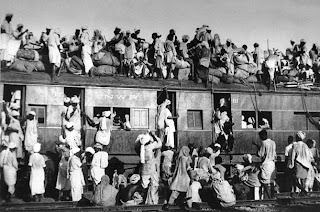
- Sacrifices of Jammu Muslims during partition
- Out break of violence
- Launch of terror on Jammu Muslims
- Massacres on Jammu Muslims
- Number of Jammu Kashmir refugees setteled in Punjab
- Refrences
1. Sacrifices of Muslims during partition of Sub continent in 1947
The
inter-religious violence that occurred in Jammu and Kashmir against
the backdrop of the 1947 Partition of India and its aftermaths included
a possible ‘ethnic cleansing’ of Jammu’s Muslims. One million Kashmiri
Muslim refugees were uprooted and an estimated 2,500,00 to 300,000 were
massacred in the Jammu region alone in August-October 1947. Violence
was directed in the main by the Dogra Hindu state troopers aimed at
driving them out from fear of death. Despite the grwoing concerns of
the ‘new history’ of Partition, until recently it has been dominated by
the Punjab experience of violence and mass migration. This has been to
the detriment of other regions such as Jammu which experienced a
similar pattern of disruption, one that was equally profound. It
reflects on the circumstances which led to the mass killings and the
empting of Jammu’s Muslims in the region at the Partition of Indian
subcontinent. It draws on original sources to explain the scope,
motivation and purpose of the localized acts of violence.
The outbreak of event was West Punjab communal disturbances from March
1947 onwards to the subsequent development of Jammu violence in
August- October that year. The Muslims of Jammu were geographically
economically and ethnically linked with the West Punjab’s cities and
towns and this proximity proved significant as it enabled displaced
persons to flow easily into and out of Jammu province. By the end of
1947, over 300,000 Kashmiri refugees had arrived in Gujranwala and
Sialkot.
2. Outbreak of violence
The
March 1947 violence in the Punjab followed on from growing tensions
that had accompanied the previous year’s provincial elections. On the
second March 1947, the ‘precipitating event’ for the outbreak of
widespread violence in the Punjab was the fall of the Khizr Hayat Tiwana
coalition Unionist government which was formed without the Muslim
League’s participation were accompanied by mass agitation that turned
violent the leading cities of Punjab. The disturbances began in Lahore
but spread rapidly Rawalpindi, Attock and Multan.
The worst
violence occurred in Rawalpindi division where serious rioting began
during the first week of March. The raiders, some of whom were from the
North West Frontier Province, but also included local Punjabis not
only burned and looted many non-Muslim villages in the region but also
looted and gutted ‘Murree hill stations’ which were used by British
troops during the hot weather.
A particular facture of the March
violence was ‘the genocidal aspect’ of violence. There was a general
agreement that these attacks on Hindus and Sikhs were ‘carefully
planned and carried out’ and reportedly led by some retired Muslim army
officers.
According to an
official estimate, by mid-March more than five thousand Hindus and
Sikhs were killed in these raids, and more than fifty thousand took
shelter in the hurriedly established camps of Wah Attock and Kala
Rawalpindi. The gravity of growing tension can be gauged by a fact that
the special armoured trucks and tanks were sent to Rawalpindi and
Attock to defuse the situation. In the aftermath of the Rawalpindi
killings, Hindus and Sikhs of the Punjab demanded the division of the
province along with the division of India.
In such a climate of fear and uncertainty, by
April 1947, non-Muslims from the violence in the Rawalpindi division
were arriving in other parts of the Punjab and the Kashmir region,
expecting to return after the violence ceased. With in a week of the
killings, ‘a large flock’ of the Hindus and Sikhs from Rawalpindi
division started migrating to neighboring Kashmir region.
3. Launch of Terror on Jammu Muslims
The embittered Sikh and Hindu refugees’ tales of violence raised
animosities wherever they settled. They planned revenge and produced and
circulated wildly inflammatory pamphlets and brochures. Their
horrified tales of the Muslim perpetration circulated widespread and
served as an occasion to launch a reign of terror on the Jammu Muslim
population. Shortly flight and violence went hand in hand. Violence
Jammu was increasingly locked into an all-India pattern, as killings in
one part of the country were justified as retribution for violence in
another part. Jammu’s Muslims were to pay a heavy price in
September-October 1947 for the early disturbances in the West Punjab.
At the time also the Dogra Hindu Maharaja Hari Singh’s own preference
was that the State should remain independent or accede to India,
knowing that majority of the State’s populace was inclined to link its
future with Pakistan. In order to maintain his stranglehold, the
Maharaja had initiated systematic tyrannical campaign against the
‘dissenters’ as early as the outset of May.
By the mid-August,
the state administration had not only demobilised a large number of
Muslim soldiers serving in the state army but also the Muslim police
officers, whose loyalty was suspected, had also been sent home. The
State’s Muslim majority contagious to the Punjab, particularly in
Poonch, started organizing resistance forces in the border districts,
There were regular reports of ‘persecutions’ and ‘mass murders of
Muslims in Poonch’.
The violence
sparked off an exodus and Muslim refugees flowed in the opposite
direction. A large number of Kashmiri Muslim families from Poonch
started pouring into the border districts of Rawalpindi, Jhelum, Gujrat
and Sialkot.
The refugees related harrowing tales of massacres by the state Dogra
troopers. This image of Kashmir inflamed the Punjabi Muslims and, in
particular stirred up the movement of tribes of North-West Frontier
Province.
The Muslim Pukhtoon tribes of North-West Frontier Province stirred up
the movement . The raiders who numbered about 20,000 crossed the border
and smuggled arms into Kashmir. They, along with the Muslim army
deserters from the state forces and retired army men, came to help rouse
the peasantry of Poonch. Indeed around 60,000 Poonchis and other ‘hill
men’ had served in the British Indian Army during the Second World
War. There were also rumours of the Pakistan Army’s assisting to the
‘Provisional Government’ of North Frontier Province in such raids. Their
activities grew into a full-scale revolt against the Dogra rule and
culminated in the form of the ‘liberation’ of an area in western Jammu
and Kashmir and proclaimed the independent ‘Azad’ Kashmir on 24 October
1947. On 26 October the Maharaja fled from Srinagar to Jammu as the
threat of ‘liberation’ armed activists poised to capture the city. In
the backdrop of the revolt, the ‘hill men’ (raiders) besieged Kotli for
nearly a month and Poonch for half month, killing many non-Muslims
ruthlessly. They particularly made ‘a practice of killing the leading
banias (shopkeepers) and then inviting local villagers to join in
looting their property’. They also specifically targeted the state
officials to drive them out of the areas. Krishna Metha provides a
rambling account of her days in and around Muzaffarabad at the time of
tribes’ raids in the Kashmir province. She writes her husband was
escorted by the tribesmen who ‘drew their guns at him and shouted, You
kafir, [infidel] go on your knees and prostrate before us, we represent
Pakistan. He stood motionless. Tell us if you are a Hindu or a
Mussalman? they demanded. When he said he was a Hindu, they all fired at
him one after the other’.
In less then
two months, a large stream of Hindus and Sikhs was forced to migrate to
the ‘other’ part of Kashmir. Many thousands took refuge in the state
garrisons which had not received food from outside since the attacks
began. Because of the difficult terrain, worse than in the North-West
Frontier- and the poor conditions of the roads, the movement of
refugees was very slow. Many who strangled in the mountains were killed
and fortune ones took shelter in the army state run Yol Camp, where
they had to wait years for their departure to India. The last batch of
900 Hindu and Sikh Kashmiri refugees and over 250 former employees of
the Dogra state administration, were ‘repatriated’ to Amritsar in
January 1951. A survivor Sardar Inderjit Singh recalls of his
family’s migration from Kashmir to Amritsar: ‘Father had put me on his
shoulders while crossing the river. He dropped me, saying now you run
up the mountain and I will come after you. There was gun fire…my father
could not be found’
4. Massacres on Jammu Muslims
The situation was much the same in Jammu. The danger for Muslims
multiplied ‘every hour’ as hordes of Hindu and Sikh refugees started
pouring into Jammu from areas that were going to become Pakistan. In
April, the first trickle of refugees had already arrived in Jammu
followed the March 1947 violence in Punjab Rawalpindi, Attock, Murree,
Bannu and Hazara. The daily flood peaked in late 1947 when an estimated
160,000 population of Hindus and Sikhs migrated from the western
districts of Pakistan. By that time, majority of the non-Muslim
population of Sialkot had fled to Jammu during the partition-related
disturbances. Sialkot and Jammu were nothing less than twin cities. The
north-eastern part of Sialkot was principally inhabited by the Dogras
inhabitants. They were closely linked culturally and linguistically with
the Hindu Dogras of Gurdaspur on the one side and Jammu on the other.
As the Punjab boundary award was announced and the disturbances
worsened, about 100,000 Hindu and Sikh refugees from Sialkot migrated to
Jammu.
In Jammu city alone, by mid- September,
they numbered 65,000. Their arrival brought the communal tension to
‘the breaking point’. They carried with them harrowing stories of
Muslim atrocity, which were retold in the press and given official
sanction by the state media. For example, a Jammu based Hindu paper
boasted that ‘a Dogra can kill at least two hundred Muslims’ which
illustrated the communal level to which the media and parties had sunk.
This further intensified the Muslim killings and exodus. Almost
immediately, the disgruntled Dogra refugees backed by their relatives
from Jammu started a general clearing of the Muslim population. They
were provided arms and ammunition by the state officials. Sikh
deserters of the Sialkot Unit, who migrated in Jammu and also had taken
away with themselves rifles and ammunition now utilised them.
The daily
Telegraph of London journalist reported on 12 January 1948: ‘Yet
another element in the situation is provided by Sikh refugees from the
West Punjab who have sized Muslim lands in Jammu… they originated the
massacres there last October to clear for themselves new Sikh territory
to compensate for their losses in Pakistan and to provide part of the
nucleus of a future Sikhistan’.
To make an explicit assessment of
Jammu’s Muslim massacre by the State-sponsored bid to change
demographics in 1947, it is necessary to look at the composition of the
population in the region at time. According to the Census of 1941, the
eastern half the Jammu province, cutting across small strip of Punjab
plain was inhabited by 619,000 non-Muslims, including 10,000 Sikhs and
305,000 martial Dogras Rajputs and Brahmins, and 411,000 Muslims.
Forming 40 per cent of the population of this whole area, to the north
and astride the Chenab Muslims were in a majority in the Riasi, Ramban,
and Kishtwar areas and nearly attained parity in Bhadrawah. Within the
province, the position of the majority of Muslims and Hindus in part
explains their differing aspirations for the future of the state. At
the same time, it contained elements of segmented and precarious
society, theorized by Leo Kuper, which were likely to explode into
‘genocidal violence’ during a crisis.
It is important
to point out here that the Muslim population of Jammu province largely
consisted of the Punjabi speaking. The Muslims of western Jammu had
well-established geographic, historic, economic ethnic and cultural
connections with the West Punjab’s cities and towns. They had strongly
favoured joining Pakistan. Unlike the Kashmiri speaking Muslims of the
Valley supported the secular leadership of Sheikh Abdullah. Within
Jammu province, the location of the majority of Muslims and Hindus
partially explains their differing aspirations for Jammu and Kashmir.
Overall, the Dogra Hindus formed a narrow minority in Jammu province,
though they formed a majority in its eastern districts such as
Udhampur, Kathua and the Chenani Jagir. Seventy-five per cent of
Jammu’s Hindus lived in these four districts which were contiguous to
Hindu-majority districts of Punjab such as Gurdaspur, which was
incorporated into India in 1947. The majority of Muslims in Jammu
province lived in the western districts of Mirpur, Reasi and Poonch
Jagir and they were contiguous to the towns and cities of the Punjab.
Their proximity to Punjab proved significant as they enabled refugees to
flow approachably into and out of Jammu province at partition.
Communal division was much stronger in these areas. Both the RSS and
Jammu Muslim Conference of Chaudhry Ghulam Abbas dominated here. Almost
all the communal violence took place in Jammu province. Hundred of
thousands were killed and fled to the border cities of Sialkot, Gujrat
and Jhelum. The level of destruction was worst in Jammu city where
Muslims were in minority. Their concentration was in Ustad da Mohalla,
Pthanan da Mohalla and Khalka Mohalla. The latter was much larger than
the other two combined. These Muslim localities presented a picture of
destruction by mid-September 1947. Hundreds of Gujars were massacred in
mohalla Ram Nagar. Village Raipur, within Jammu cantonment area was
burnt down. The killings and dispersal of the Muslims from Jammu city
were a clear example of the ethnic cleansing of a locality. By mid
September, Jammu city’s Muslim population was halved.
By late
November, hundred of thousands Kashmiri refugees had arrived in the
border towns of Sialkot, Gujrat and Jhelum. The Dogra state troops were
at the forefront of attacks on Muslims. The state authorities were
also reported to be issuing arms not only to local volunteer
organizations such as RSS, but to those in surrounding East Punjab
districts such as Gurdaspur. G. K. Reddy, a Hindu editor of the Kashmir
Times said in a statement, ‘I saw the armed mob with the complicity of
Dogra troops was killing the Muslims ruthlessly. The state officials
were openly giving out weapons to the mob’. The state administration
had not only demobilised a large number of Muslim soldiers serving in
the state army, but Muslim police officers, whose loyalty was
suspected, had also been sent home. In Jammu city, the Muslim military
were disarmed and the Jammu cantonment Brigadier Khoda Box replaced by a
Hindu Dogra officer. There were also reports that the Maharaja of
Patiala was not only supplying weapons, but also a Sikh Brigade of
Patiala State troops were also operating in Jammu and Kashmir. The
state authorities intended to create a Hindu majority in the Jammu
region. The Dogra troopers ejected the entire population of Muslims of
Dulat Chak on 28 November, claiming it was a part of the state. The
troops of a Sikh Brigade raided the bordering villages and forced the
Muslims there to evacuate and go beyond the old Ujh river bed.
The daily Times
of London reported the events in Jammu with such a front page
headings: ‘Elimination of Muslims from Jammu’ and pointed out that the
Maharaja Hari Singh was ‘in person commanding all the forces’ which
were ethnically cleansing the Muslims.
After the closure
of Sialkot-Jammu railway line, the Muslims started concentrating in a
camp from isolated pockets to the large enclaves within the Jammu
Police Lines. They sought assistance from the Pakistan government to
take immediate steps to ensure their safety.
In the first
week of November, the Pakistan government despatched many buses to
Jammu city to transport the refugees into Sialkot. When the convoy
arrived at Jammu-Sialkot road, Dogra troopers, RSS men and many armed.
Sikhs attacked
the caravan and killed most of the passengers and abducted their women.
The fortunate ones managed to escape to reach Sialkot. According to a
statement of a well-educated Muslim refugee who had fled from Jammu to
Sialkot, ‘Thirty lorries carrying Muslim evacuees out of Kashmir State
were attacked by Dogra troops at Satwari in Jammu. Most of the male
members were massacred, while the women abducted. He concluded that the
official proclaimed there that ‘there was no place for Muslims in
Kashmir State and that they should all clear out’
The Hindu Dogra Princely State’s main
aim was to change the demographic composition of the region by
compelling the Muslim population. The depopulation of the Muslim
population in the Jammu region is evidenced clearly in the data of the
1961 Census of India. In Jammu province, for example, about 123
villages were ‘completely depopulated’, while the decrease in the
number of Muslims in Jammu district alone was over 100,000. The Muslims
numbered 158,630 and comprised 37 per cent of the total population of
428,719 in the year 1941, and in the year 1961, they numbered only
51,690 and comprised only 10 per cent of the total population of
516,932. Kathua district ‘lost’ almost fifty per cent its Muslim
population.
It is possible
here to point out that the inter-religious violence that occurred in
Jammu included a possible ‘genocide’ of Muslims in September-October
1947. The Maharaja of the Dogra Hindu state was complicit in the
targeted violence against Kashmiri Muslims. Out of a total of 8 lakhs
who tried to migrate, more than ‘ 237,000 Muslims were systematically
exterminated by all the forces of the Dogra State, headed by the
Maharaja in person and aided by Hindus and Sikhs’.
in the Punjab
was not comparable to the massacres of Jammu’s Muslims. What gives the
Jammu massacres a special character from the Punjab partition is that
they were mainly undertaken by the Hindu Dogra state of Jammu and
Kashmir and involved the political motives to ethnically cleanse the
Muslim population into an exodus to Pakistan so that the demographic
hurdle of the state’s Muslim majority could be removed in Jammu region.
Indeed, by the Census of 1951, Jammu province had made Hindu majority province.
5. Number of Jammu and Kashmir Refugees in the Punjab Towns, in 1950
Sialkot 11, 0,143
Gujrat 37,474
Gujranwala 4,625
Rawalpindi 5,384
Lahore 1,101
Total 161,966
By
late November more than three lakh Kashmiri refugees had arrived in
the border towns of Sialkot, Gujrat and Jhelum. Over 200,000 Jammu
refugees had arrived in Sialkot because of its geographical proximity
with Jammu region. The city with a road and railway connection from
Jammu was a logical destination for the refugees. Many Kashmiris drew
on their because of their pre-existing business and kinship ties.
Majority had far
less choice except to escape from violence. The Kashmiri refugee
population not surprisingly became the most visible community in the
city. The most fortunate occupied properties abandoned by the Hindus
and Sikhs. Many others thronged camps, schools and military barracks
platforms for many years. They squatted on railway platforms, footpaths
and every conceivable space. The least fortunate were accommodated in
the ‘most appalling’, ‘de-humanised’ and ‘like cattle’ condition in the
evacuee factories. Water and sewerage arrangements were usually
non-existent and unhygienic conditions caused health problems. Almost
all 20000 Kashmir refugees in Sialkot’s Ghanda Singh School caught
small-pox.
Refugees recounted gruesome tales of brutal massacres by the state’s
own troops and the burning of their homes and crops to a party of
Englishmen who visited the city on 21 November. The harrowing images and
stories of Muslim atrocities were retold in the press as well as in
the sermons of Friday Juma prayer. The refugee’s frustrations in trying
to find suitable accommodation and livelihood were exploited by
radical groups such as the Ahrars and the newly established
Anjaman-i-Jammu Muhajirian. They used the refugees’ frustration as a
fertile recruiting ground for their brand of politics. Paper’s daily
repeated provocations led to its being banned for a fortnight.
Earlier there
were reports that around a hundred trucks loaded with ‘tribesmen’
equipped with modern weapons and signalling system had entered the
Kashmir.
With the
controversial accession of Jammu and Kashmir to India and the arrival
of Indian troops, ‘the complexion of events’ changed in the region. In
such a warlike situation, ‘a state of panic’ prevailed at the newly
developed Sialkot-Jammu border. Now there were regular attacks ‘with
automatic weapons’ on Sialkot-Jammu and Gujrat-Jammu borders, leaving
behind several casualties on daily basis. This included over 17,000
Muslim corpses by the end of October 1947.
Being a now
border town, Sialkot saw a number of incursions from Jammu region in
the early weeks and months of independence. In one such raid on a
Sialkot border village, the Dogra troops killed about 60 Muslims and
injured 12, and carried away 11 Muslim girls. They also burned and
destroyed the crops of peasants in the border villages.
On a few
occasions, the state troopers encountered the local police and the
newly created West Punjab Home Guard, while the former with their
‘automatic weapons’ outnumbered the latter’ who lacked the resources of
arms and ammunitions. Such aftermath of Partition rarely finds its way
in the standard texts, although the accounts on the territorial claims
over the Kashmir region between India and Pakistan are
well-documented. By the turn of 1948, both India and Pakistan was
heading for a war over the territorial claims of the Kashmir region. On
January 12 that year, the Indian District Liaison Officers who wished
to recover ‘pocket clearance’ of abducted women and converts were
banned from entering Sialkot, although their work continued in
Gujranwala and other cities of the West Punjab. While the official
activities could be controlled, the border between Sialkot and Jammu
remained porous and free movement between both regions was possible.
Refugees who had managed to escape from violence
to reach West Punjab cities and towns, their plight continued many
years after their arrival. Even, the transitory period for the
processing and settlement of Kashmiri refugees was sharply different
from their counterparts from East Punjab and was much tedious and a lot
longer. The delay was rooted in government policy. At the beginning,
the West Punjab government preferred the ‘agreed areas’ refugees from
East Punjab over the Kashmiri refugees in allocating evacuee
properties. The government representatives pointed out that there were
not enough evacuee properties to allocate the Kashmiri refugees and
therefore a decision to prefer the Jammu and Kashmir refugees over
their Muslim counterparts from East Punjab would ‘lead to great
discontentment’.
The continuing
plight of Kashmiri refugees is brought home by the fact that even at
the end of 1950 over 250,000 refugees were still subsisting on
government rations in the various government–run camps, when almost all
the camps of Muslim refugees from East Punjab had been cleared.
Moreover, despite the Central government’s consideration that the
Muslims of Jammu province had suffered ‘proportionally violence more
than any other class of refugees’ and that they were targets of ‘real
genocide’,
6. References
1.
Joel E. Dimsdale (ed.), Survivors, Victims and Perpetrators: Essays on
the Nazi Holocaust (Washington: Hemisphere Publisher, 1980); Norman
Cigar, Genocide in Bosnia: The Policy of Ethnic Cleansing (Texas, Texas
University Press, 1995); David Rieff, Slaughterhouse: Bosnia and the
Failure of the West (New York: 1995); Michael
N.
Dobkowski (eds.), Genocide and the Modern Age: Etiology and Case
Studies of Mass Death (New York, Syracuse University Press, 2000).
2.
Paul Brass, ‘The Partition of India and Retributive Genocide in the
Punjab, 1946-1947: Means, Methods, and Purposes’, in Journal of Genocide
Research, 5:1 (2003): pp. 71-101; Anders Bjorn Hansen, Partition and
Genocide: Manifestation of Violence in Punjab 1937-1947 (New Delhi,
India Research Press, 2002); Ian Talbot, Divided Cities: Partition and
Its Aftermath in Lahore and Amritsar (Karachi: Oxford Uuniversity Press,
2006).
3.
Ian Copland, ‘The Master and the Maharajas: The Sikh Princes and the
East Punjab Massacres of 1947’, Modern Asian Studies, Vol. 36:3 (2002);
Shail Mayaram, ‘Speech, Silence and the Making of Partition Violence in
Mewat’, Subaltern Studies IX, (New Delhi: Oxford University Press,
1997).
4. Mukherji Saradindu, The hidden story of Kashmiri refugees (Philadelphia, Oral History Association, 1996).
5.
Seema Shekhawat, Conflict and Displacement in Jammu and Kashmir: the
Gender Dimension (Jammu: Saksham Books International, 2006).
6.
Cabeiri deBergh Robinson, Refugees, Political Subjectivity, and the
Morality of Violence: from hijarat to jihād in Azad Kashmir
(unpublished PhD dissertation, Cornell University, 2005).
7.
Robert M. Hayden, ‘Schindler’s Fate: Genocide, Ethnic Cleansing, and
Population Transfers’, Slavic Review, Vol. 55, No. 4 (winter, 1996), pp.
727-748; Geroge. J. Andreopoulos (ed.), Genocide: Conceptual and
Historical Dimension (University of Pennsylvania press, 1997); Leo
Kuper,
Genocide (Harmondsworth: Penguin, 1981).
8.
Ian Kerskaw, The Nazi Dictatorship: Problems, Perspectives of
Interpretation (London: OUP, 4th Addition, 2000). Particularly see the
chapter 5, pp. 93-133.
9.
Sumantra Bose, Kashmir: Roots of Conflict, Paths to Peace (Harvard
University, 2003); Prem Shankar Jha, The Origins of a Dispute: Kashmir
1947 (New Delhi: Oxford University Press, 2003; Mridu Rai, Hindu Rulers,
Muslim Subjects: Islam, Rights, and the History of Kashmir (New Delhi:
Permanent Black, 2004); Chitralekha Zutshi, Languages of Belonging:
Islam, Regional Identity, and the Making of Kashmir (New Delhi:
Permanent Black, 2004); Victoria Schofield, Kashmir in Conflict: India,
Pakistan and the Unfinished War (London: 2000); Alastair Lamb,
Incomplete Partition: the Genesis of the Kashmir Dispute, 1947-48
(Hertingfordbury, 1997).
10.
For the background to both the agitation and to Punjab politics after
the formation of the Unionist Party see, Ian Talbot, Khizar Tiwana, The
Punjab Unionist Party and the Partition of India (London: Richmond,
1996), pp. 145-156.